
In the late summer of 2020, when the world felt strangely suspended and the days blurred into one another, I found myself writing music that didn’t quite fit anywhere. ScarKord had always been my outlet for electronica, remixes, and rhythmic experimentation, but what emerged during those lockdown evenings was slower, more cinematic, more introspective. It felt like a different voice and I wasn’t sure it belonged under the name I’d been using for years.
Then came the moment that tipped everything over: someone I’d never met released a techno track under the artist name “Jason Vine”. Not their real name — just borrowed. And the track was called, with almost painful irony, “Losing Myself.” It was hard not to laugh. At a time when I was already questioning where my own musical identity sat, here was a stranger accelerating the crisis.
So I dusted off an alias I’d been toying with for a while — Aesonix, a loose nod to Greek mythology and my own name (Aeson being the father of Jason, leader of the Argonauts) — and let it become the home for this new, more atmospheric work.
These experiments would eventually become the Horizons EP.
A Constraint Becomes a Catalyst
All four tracks began as part of Sound Aesthetics Sampling’s Show Us Your Music promotion. The rules were simple: every sound had to come from their Kontakt libraries, in my case, I used Fragments, Mountains and Talua.
None of these were designed for percussion, bass, or rhythmic material — which, as it turned out, was exactly what made the challenge so creatively energising. The constraint gave me something to push against. It forced me to coax unexpected textures out of melodic snapshots, to build drum kits from bell tones, and to treat every sound as raw material rather than a finished instrument.
Those limitations shaped the sonic identity of the entire EP.
Track 1. Life in Pieces
Life in Pieces was the first track I wrote, and the one that set the tone for everything that followed. Built entirely from the Fragments library, it began with a single snapshot — Sub Balimba — which I processed into a metallic, ringing clang using only stock Ableton plugins including Erosion and Corpus. I played with the tuning a bit, and in the end pitched it up two octaves along with some Valhalla Shimmer Reverb.

A second copy of the sound pitched up 4 octaves made for a pseudo clave sound, a brittle percussive tick. The kick drum came from the same sound source, just with a 10db boost and some EQ to filter out the top-end.
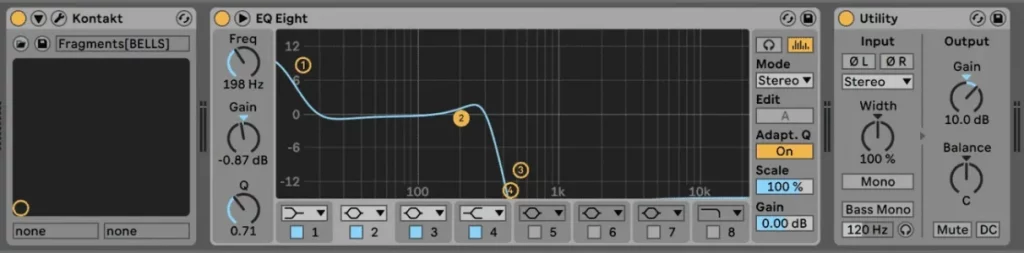
Once I had a palette, I built a drum kit from these resampled fragments and let a rhythm emerge.
The arpeggios came from Ableton’s arpeggiator, processed and coloured by Shaperbox. There are a couple of Shaperbox presets in particular which are good for adding harmonics and interest to the sounds. Add high note which creates the high note clusters, and Plus an octave which widens the sound.
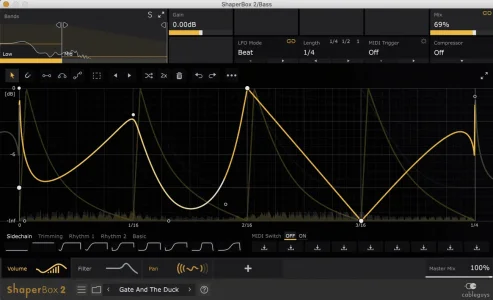
The bassline started from the Fragments snapshot Bass Pulses which is in Fragments [PADS]. It’s a great sound, but very wide and dominant, so I needed to reign it in a bit to make it sit better with the other parts. Ableton’s Utility plugin narrowed the width and once again, I used Shaperbox but with a pretty severe gating effect on it to make it sit inside the groove rather than overwhelm it.
The final piece of the jigsaw was a counterpoint, DX‑like synth line that emerges halfway through the track. It forms part of the more melancholy middle section, where the harmony falls rather than rises — a gentle descent that contrasts with the upward‑leaning opening and closing passages. That repetitive figure threads through the falling section, with its last note ringing out as the music turns and begins to climb again. I processed it through Softube Spring, one of my favourite reverbs, which gave it a warm, slightly wobbly halo that softened the digital edges and helped it settle into the atmosphere of the piece.
It was the first time in years I’d felt genuinely joyful in my process. And it was the moment I realised Aesonix might be more than a temporary diversion.
Track 2. Strange Resonances
A month later, I returned to the constraints idea with Mountains and Talua, two Sound Aesthetics libraries full of glassy strings and bell tones. Strange Resonances came together quickly — darker, more brooding, with just a hint of Massive Attack’s “Paradise Circus”, otherwise known as the theme song to BBC’s Luther.
The percussion was once again built from non‑percussive sources. The Attack Bell preset from Talua became the backbone: bitcrushed and distorted through Audio Damage Grind, pitched down two octaves with Discord 4, and dirtied with Ratshack reverb. I also used the Ableton Erosion, Resonator and Frequency Shifter plugins to sculpt the sound further.
Multiple filtered and pitched versions became hats, snares, and accents. I reused the kick from Life in Pieces to keep a sense of continuity. There’s also some lovely percussive vowel‑sound filtering woven into the groove — almost like a scratched vocal sample — which added a human, textural quality to the rhythm that I was particularly pleased with.
Looking back through the Ableton session, I can see that the Glass Pulses motif — the mallet‑like figure that threads through the track — was processed through Surreal Machines’ Diffuse plugin. It’s a wonderfully characterful effect, evoking those slightly artificial, early‑digital reverbs from the ’80s. Not “authentic” in any purist sense, but full of personality.
Track 3. The Climb
The third track, The Climb, arrived during a rare free evening in September. Built primarily from the Mountains library (hence the name) it felt like the natural endpoint of the series — more optimistic, more textural, more adventurous.
The glitchy intro loop began as a resampled version of Sub Balimba (again), pitched down an octave and mangled through iZotope Trash 2. Shaperbox added movement; AAS Objeq Delay added tabla‑like echoes that bounced across the stereo field.
The “helicopter” sound that fades in around the ten‑second mark started life as Rich String from Mountains, pitched down two octaves and pushed through Sausage Fattener and Audio Damage Grind until it became an atonal, flapping noise. It was a bit too dubstep for my taste, so I smoothed it with Shaperbox 2 to give it a more pleasing rhythmic shape.
Revisiting the Ableton session, I noticed that the string parts are running through one of my “secret weapons”: OSL Chorus, a beautifully lush Juno‑60‑style chorus plugin from Oblivion Sound Lab.
Track 4. Strange Resonances (ScarKord Remix)
Then came the identity‑crisis moment.
I sped Strange Resonances up by nearly 50bpm just to see what would happen — and it worked. The drums needed reshaping, so I leaned into a UK Garage / 2‑step feel, building a broken beat that gave the track a completely different energy. Once the tempo felt right, I repitched the snare drums and used Native Instruments Dirt on the kick to make it more punchy, then added a new interweaving synth‑arpeggio intro to pull the listener into this faster, more restless version of the track.
From there, the remix took on a life of its own. I wrote additional string parts to create a new breakdown section, evoking the eerie, suspended quality of Angelo Badalamenti’s Twin Peaks theme — a moment of stillness inside the momentum. After a reprise of the 2-step drums, the remix erodes back to the arpeggio and fades, as if dissolving into its own source material.
The result was the ScarKord Remix, a strange loop where I ended up remixing myself.
Finding the Horizon
When I stepped back and listened to the three tracks together — plus the remix — they felt like fragments of the same moment in time. Lockdown had compressed everything: days, emotions, routines. But these pieces of music felt like small windows opening outward, each one pointing toward something beyond the immediate present.
That’s where the title came from.
Horizons — not a destination, but a direction.
Recording the EP as Aesonix gave me the freedom to explore a different side of my musical identity without the weight of expectation. It let me be playful and a little anonymous. And yet, despite finishing the tracks in 2020, I didn’t release them. They sat quietly on Soundcloud for years until I remastered them in February 2025, but even then I hesitated.
Looking back, that delay makes sense. The EP captured a very specific kind of creative energy — the kind that comes from limitation, uncertainty, and the need to make something just for the sake of making it. It took time to feel ready to share that. But once I did, it felt like closure. In its own small way, Horizons helped me find momentum again.